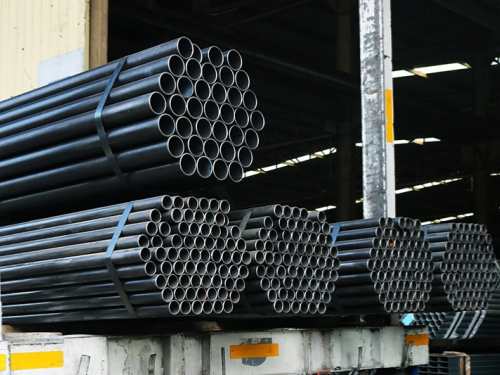
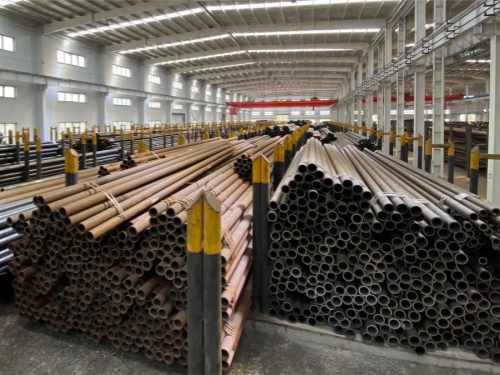
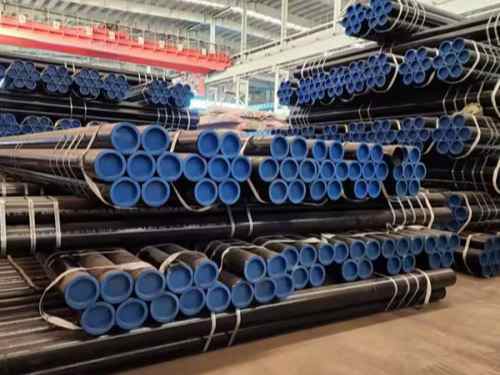
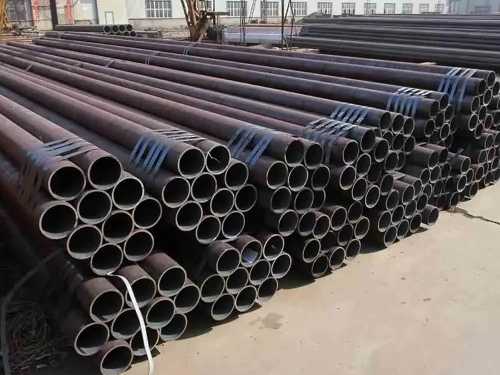
ASTM A500 Grade B Hollow Section is one of the most widely specified structural steel tubing materials in North America and international export markets. It is produced in accordance with ASTM International under the standard ASTM A500 – Cold-Formed Welded and Seamless Carbon Steel Structural Tubing in Rounds and Shapes.
Due to its optimized balance of strength, weldability, availability, and cost efficiency, Grade B is extensively used in:
Steel building frameworks
Industrial plants and warehouses
Bridges and transmission towers
Mechanical support structures
Infrastructure and energy projects
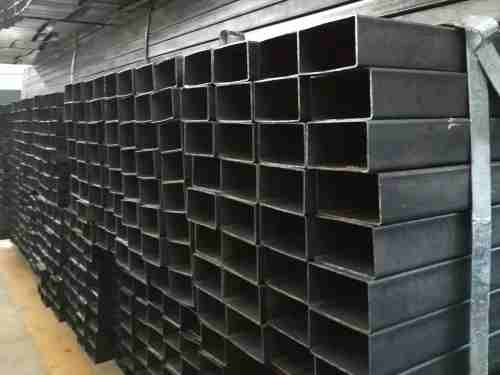
What Is ASTM A500?
ASTM A500 is the standard specification covering cold-formed welded and seamless carbon steel structural tubing, available in:
Round (HSS Round)
Square (HSS Square)
Rectangular (HSS Rectangular)
The specification includes four grades:
Grade A
Grade B (most commonly specified)
Grade C
Grade D
Among these, Grade B is the dominant choice for general structural engineering due to its balanced mechanical profile.
Basic Material Characteristics of ASTM A500 Grade B
ASTM A500 Grade B belongs to the carbon structural steel category within the ASTM system and is primarily used for cold-formed welded structural components.
Key Characteristics:
Moderate yield strength
Excellent weldability
Good ductility and toughness
Stable cold-forming performance
Wide dimensional availability
Typical Mechanical Properties (ASTM A500/A500M-22)
|
Property
|
Requirement
|
|
Yield Strength (YS)
|
≥ 315 MPa (46 ksi)
|
|
Tensile Strength (TS)
|
≥ 400 MPa (58 ksi)
|
|
Elongation (50.8 mm gauge length)
|
≥ 21%
|
|
Bending Test
|
180° bend, no cracking (mandrel = 3× wall thickness)
|
Structural Shapes of ASTM A500 Grade B
- Square Hollow Section (HSS Square)
Advantages:
Higher bending resistance compared to round tubes
Superior torsional stability
Efficient load distribution in frame structures
Clean architectural appearance
Widely used in:
Building columns
Steel frames
Equipment supports
Modular construction systems
- Rectangular Hollow Section (HSS Rectangular)
Advantages:
Optimized moment of inertia along major axis
Ideal for beam and girder applications
Space-efficient structural design
Common applications:
Beams and lintels
Platform structures
Machinery bases
- Round Hollow Section (HSS Round)
Advantages:
Uniform stress distribution
Excellent torsional resistance
Reduced stress concentration
Applications:
Poles and towers
Trusses
Offshore and energy structures
Mechanical Advantages of ASTM A500 Grade B
- High Yield Strength for Structural Safety
With a minimum yield strength of 315 MPa, the material provides elastic stability under service loads and controlled plastic deformation under overload conditions, allowing structural warning before failure.
- Strong Tensile Capacity
Minimum tensile strength of 400 MPa ensures reliable resistance against fracture under maximum design loads.
- Good Ductility
Elongation ≥21% enhances:
Impact resistance
Seismic performance
Brittle fracture resistance
- Excellent Cold-Forming Performance
The 180° bend test without cracking confirms reliability during fabrication and forming operations.
Comparative Advantage: ASTM A500 Grade B vs Q235B
Compared with Q235B under GB/T 6728:
|
Parameter
|
A500 Grade B
|
Q235B
|
|
Yield Strength
|
≥315 MPa
|
≥235 MPa
|
|
Tensile Strength
|
≥400 MPa
|
~370–500 MPa
|
Performance Gain:
Yield strength approximately 34% higher
Allows 15–20% weight reduction under identical load conditions
Enables lightweight structural design
Reduces material consumption and transport cost
For engineering projects focused on optimization, Grade B provides better strength-to-weight efficiency.
Why ASTM A500 Grade B Dominates Global Structural Markets
ASTM A500 Grade B has become a universal structural framework material because it offers:
Predictable mechanical performance
Mature global supply chain
Broad dimensional inventory
Compatibility with North American design codes
Strong export acceptance
From high-rise buildings in New York to energy facilities in the Middle East and mining equipment worldwide, it supports heavy structural loads with precision manufacturing tolerances.
FAQ
Q1: Is ASTM A500 Grade B suitable for load-bearing structures?
Yes. It is widely used in primary structural applications including columns, beams, and load-bearing frameworks.
Q2: Is A500 Grade B welded or seamless?
It can be produced as cold-formed welded or seamless structural tubing, depending on manufacturer capability.
Q3: Can ASTM A500 Grade B replace Q235B?
In many structural scenarios, yes. Due to higher yield strength, it allows lighter design under equivalent load requirements.
Q4: Is ASTM A500 Grade B good for seismic regions?
Its ductility and elongation performance make it suitable for seismic-resistant structural systems when designed according to local codes.
Conclusion
ASTM A500 Grade B Hollow Section represents an optimal balance between strength, toughness, manufacturability, and economic efficiency.
As infrastructure moves toward lightweight, high-performance, and sustainability-driven engineering, Grade B continues to serve as a foundational structural steel solution for global construction and industrial projects.

 English
 Español